Independence
A and B are independent, denoted
Conditional independence
Notion:
Bayes' Rule
Product rule
or in distribution form
Useful for assessing diagnostic probability from causal probability:
An example of naive Bayes model:
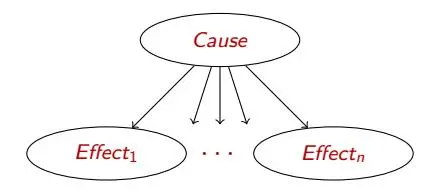
Total number of parameters is linear in
Bayesian network
A simple, graphical notation for conditional independence assertions and hence for compact specification of full joint distributions.
Syntax:
- a set of nodes, one per variable
- a directed, acyclic graph (link ≈ "directly influences")
- a conditional distribution for each node given its parents:
(CPD)
In the simplest case, conditional distribution represented as a conditional probability table (CPT) giving the distribution over
Example: 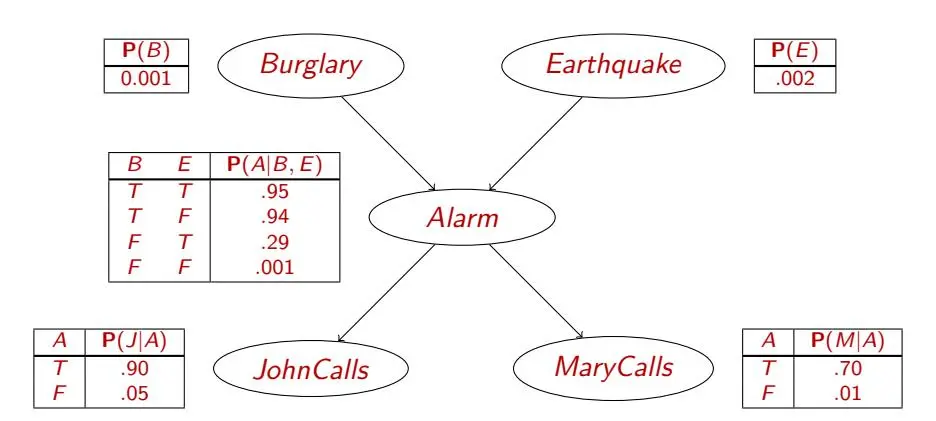
Global semantics
Global semantics defines the full joint distribution as the product of the local conditional distributions:
active trail
Let Z be a subset of observed variables.
The trail
, or one of its descendants are in Z - no other node along the trail is in Z
direct separation(d-seperation)
Two sets of nodes X, Y are d-separated given Z if there is no active trail between any
To determine if X and Y are independent given Z:
- traverse the graph bottom-up marking all nodes in Z or having descendants in given Z
traverse the graph from to , stopping if we get to a blocked node - if we can't reach Y, then X and Y are independent
A node is blocked if either the middle of an unmarked v-structure, or in Z (not both)
Local semantics
Local semantics: each node is conditionally independent of its nondescendants given its parents
Theorem: Local semantics ⇔ global semantics
Markov blanket
Each node is conditionally independent of all others given its Markov blanket: parents + children + children's parents